

Ever stared at a spring fitting and thought, “Is this engineering or a metal slinky prank?” You’re not alone—most of us just nod, tighten something, and secretly hope nothing launches across the room.
This guide explains how spring fittings actually work, step by step, so you can choose, install, and troubleshoot them with confidence—backed by standards like ISO 4414 pneumatic system safety guidelines.
🔧 Overview of Spring Fitting Structures and Key Functional Components
Spring fittings convert stored elastic energy into controlled motion. Their structure links springs, cable drums, and shafts so doors, gates, or machines move smoothly and safely.
By understanding each component, engineers can size springs correctly, reduce wear, and improve long‑term reliability in industrial, commercial, and residential installations.
1. Core Spring Body and Coils
The core body is usually a helical torsion or extension spring. Coil diameter, wire size, and number of active coils determine torque capacity and travel.
- Material: high‑strength spring steel or alloy
- Shape: closely wound or open‑wound coils
- Finish: painted, plated, or oiled for corrosion control
2. Shafts, Anchors, and Bearings
Shafts carry torque from the spring to the drum. Anchors fix one spring end, while bearings support rotation and keep alignment under repeated load cycles.
- Hollow or solid steel shafts
- Rigid anchor brackets to resist slip
- Sealed bearings to limit friction and noise
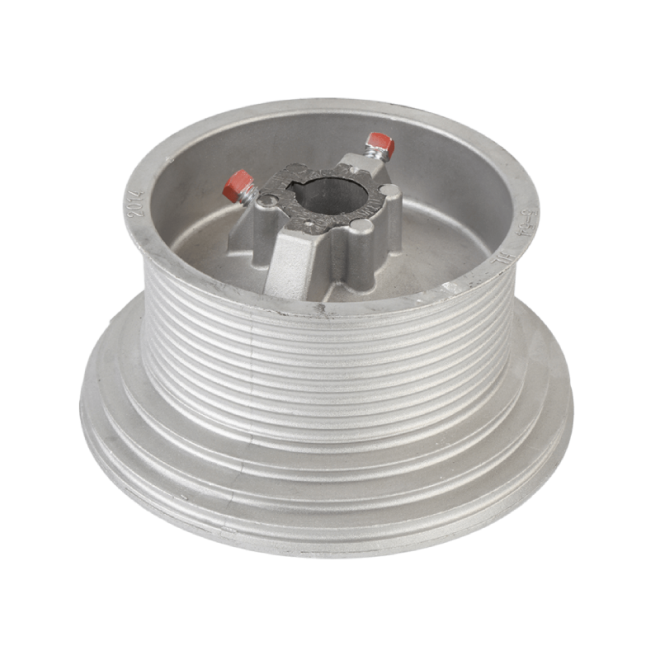
3. Cable Drums and Motion Transfer
Cable drums wind and unwind lift cables with tight control of travel. The groove profile sets cable path, balance, and maximum lifting height.
- 9′ Cable Drum | Standard Garage Door Cable Drum – Model WT-D10002 for typical home doors
- Drum choice must match door weight and track radius
4. Safety Devices and Couplings
Safety parts stop uncontrolled movement if a cable breaks or a spring fails. Couplings connect several springs to share load evenly.
| Component | Main Function |
|---|---|
| Safety device | Locks motion during failure |
| Flexible coupling | Aligns shafts, reduces shock |
⚙️ How Elastic Deformation Enables the Spring Fitting Working Principle
Spring fittings work by elastic deformation. When you wind or stretch the spring, it stores energy, then releases it as controlled torque or linear force.
This reversible deformation lets doors open with low effort while the spring system quietly takes most of the load and returns it when closing.
1. Energy Storage During Winding
When you rotate the shaft, coils twist. Shear stress rises inside the wire, and the spring stores potential energy proportional to deflection angle.
- More turns = higher torque
- Stay within rated maximum turns
- Use calibrated winding bars for safety
2. Controlled Release During Operation
As the door moves, the spring unwinds. The release of torque lifts the load while cable drums keep speed and travel within a safe, set range.
| State | Spring Condition | Door Motion |
|---|---|---|
| Fully wound | High stored energy | Door closed |
| Half wound | Medium energy | Door mid‑travel |
| Nearly relaxed | Low energy | Door open |
3. Bar Chart: Torque vs. Door Position
The following code sample uses ECharts to plot a basic torque‑position bar chart for a torsion spring fitting.
4. Role of Damping and Friction
Friction in bearings and drums slightly reduces effective torque. Proper lubrication and smooth cable grooves keep motion stable and reduce noise and wear.
- Check bearing temperature and noise
- Keep cables clean and correctly tensioned
📏 Load, Deflection, and Stress Relationships in Spring Fittings
Load, deflection, and stress are closely linked. Correct calculations let you select a spring fitting that supports door weight without overstressing the wire.
1. Basic Load–Deflection Behavior
Within the elastic range, spring torque or force rises almost linearly with deflection. Engineers often use rated “spring rate” to estimate needed turns.
- k = torque ÷ angular deflection
- Stay within catalog deflection limits
2. Stress Limits and Fatigue Life
High cyclic stress can cause fatigue cracks. Lower stress levels extend life, so heavy doors often use several springs to share the total torque.
| Stress Level | Typical Life (Cycles) |
|---|---|
| Low | 50,000–100,000 |
| Medium | 25,000–50,000 |
| High | Below 25,000 |
3. Influence of Cable Drum Selection
Drum diameter converts torque into lifting force. A larger drum needs more torque but offers longer travel, so matching drum and spring is essential.
- Heavier doors: larger torque, robust drums
- Tall doors: extended‑reach or extra‑long drums
🧪 Common Failure Modes and Technical Inspection Methods for Spring Fittings
Knowing typical failure modes helps maintenance teams find problems early. Regular inspections greatly reduce sudden breakdowns and safety incidents.
1. Spring Fracture and Surface Damage
Fractures often start from corrosion pits or deep scratches. Inspect coil surfaces, end hooks, and inside faces for rust, wear marks, or microcracks.
- Look for gaps between broken ends
- Replace springs in matched pairs
2. Cable and Drum Wear Issues
Misaligned cables cut into drum grooves and reduce safety margin. Check groove shape, cable tension, and winding pattern at scheduled intervals.
| Symptom | Possible Cause |
|---|---|
| Flattened grooves | Overload or wrong drum type |
| Cable fraying | Sharp edges or mis‑routing |
3. Practical Inspection Procedures
Use a checklist approach. Verify torque balance, measure door travel, and listen for unusual sounds to detect hidden problems before they grow serious.
- Test manual lift force
- Check cycle counter and service records
🏭 Engineering Application Cases and Selection Guidelines from WELL LIFT
WELL LIFT spring fittings support doors from light residential use to heavy industrial doors. Correct matching of springs and cable drums ensures long, stable service.
1. Residential and Light Commercial Doors
Standard garage doors often use compact fittings with matched torsion springs and drums. WELL LIFT provides stable, low‑noise options for frequent daily use.
- Balanced lift for smooth manual or motor drive
- Optimized for typical door widths and heights
2. Extended and Extra‑Long Door Systems
For taller or special doors, engineers need drums with greater cable capacity. WELL LIFT offers solutions for extended travel and higher lift demands.
- 18′ Cable Drum | Extended Reach Cable Drum – Model WT-D10006 for higher vertical lift
- 120′ Cable Drum | Extra-Long Cable Drum System – Model WT-D10010 for very tall or special projects
3. Practical Selection Guidelines
Define door weight, clear opening height, cycle life, and safety level. Then choose spring size, drum model, and shaft layout to match these values.
| Parameter | Design Focus |
|---|---|
| Door weight | Spring torque capacity |
| Door height | Drum cable capacity |
| Cycles per day | Fatigue rating and material |
Conclusion
Spring fittings work by storing energy in elastic coils and releasing it as smooth, controlled motion. Correct structure, stress control, and inspection keep systems safe.
By matching springs, cable drums, and shafts to real door loads, WELL LIFT solutions deliver stable performance, long life, and simple maintenance for many applications.
Frequently Asked Questions about spring fitting
1. What is a spring fitting in a door system?
A spring fitting is the full assembly of springs, cable drums, shafts, and supports that balances the door weight and allows easy, safe opening and closing.
2. How often should I inspect torsion spring fittings?
For most commercial doors, inspect visually every three months and perform a detailed functional check at least once a year, or more for heavy‑cycle use.
3. When must a spring be replaced instead of adjusted?
If the spring shows cracks, visible deformation, severe corrosion, or can no longer balance the door within its rated turns, replace it rather than adjust it.
4. Can I mix different spring models on the same shaft?
It is not recommended. Always use matched springs with similar rate and size so they share load correctly and avoid uneven stress or early failure.
5. Why is correct cable drum selection so important?
The drum converts spring torque into lift. A wrong drum can cause poor balance, reduced travel, higher stress, and faster wear on cables and springs.